Skip to content
AS Andrea Santoro
45.07°N 7.69°E · Turin
Sheet 02 — Research themes Rev. 2026.10

Research themes

The themes I work on, from methods for multivariate signals to sperm whales and food.

Time Series Analysis
§2.1

Time Series Analysis

Methods to analyze multivariate signals

  • Forecasting methods for complex time series
  • Higher-order inference in temporal data
  • Arrow of time in time-varying signals
Brain connectivity network representation
§2.2

Computational Neuroscience

Computational approaches to understand neural systems, from micro- to macro-scale. The work runs along three threads, from methods to emotion to patients:

2.2.1 Temporal & higher-order methods for fMRI topology · fingerprints
Higher-order co-fluctuations in temporal data

Methods that go beyond static, pairwise connectivity: instantaneous higher-order co-fluctuations reconstructed from fMRI time series, topological and information-theoretic measures of group interactions, edge-based signal processing, and the individual fingerprints these reveal.

2.2.2 Affective neuroscience emotion · naturalistic film fMRI
Film stills and brain activity used to study emotion

Emotions are thought to emerge from co-activation among distributed brain systems, yet traditional fMRI analyses mostly look at localized responses and pairwise connections. Using naturalistic paradigms such as film viewing, where emotions unfold continuously rather than in isolated trials, I study how groups of brain regions interact as an emotional experience builds, peaks and fades, and how that experience can be read back from brain activity alone.
  • Higher-order signatures of emotion. Time-resolved higher-order topology of fMRI during naturalistic viewing of 14 films, continuously annotated across 50 affective features (bioRxiv 2026; talk at OHBM 2026)
  • Complementary representations. Higher-order topology captures fine-grained affective structure, while pairwise connectivity provides a portable readout of broad arousal
  • Emotion in large-scale brain dynamics. Ongoing work on how whole-brain activity evolves over time with the emotional content of naturalistic stimuli
  • Multi-scale shape of emotional dynamics. Mapper graphs that summarise how brain states recur and transition as the films unfold
  • Individuals and behaviour. Functional fingerprinting during emotional short films, and brain–behaviour associations in film fMRI (OHBM 2025 poster)
  • Open student project: temporal dynamics of emotion using film fMRI
2.2.3 Clinical neuroscience stroke · tinnitus
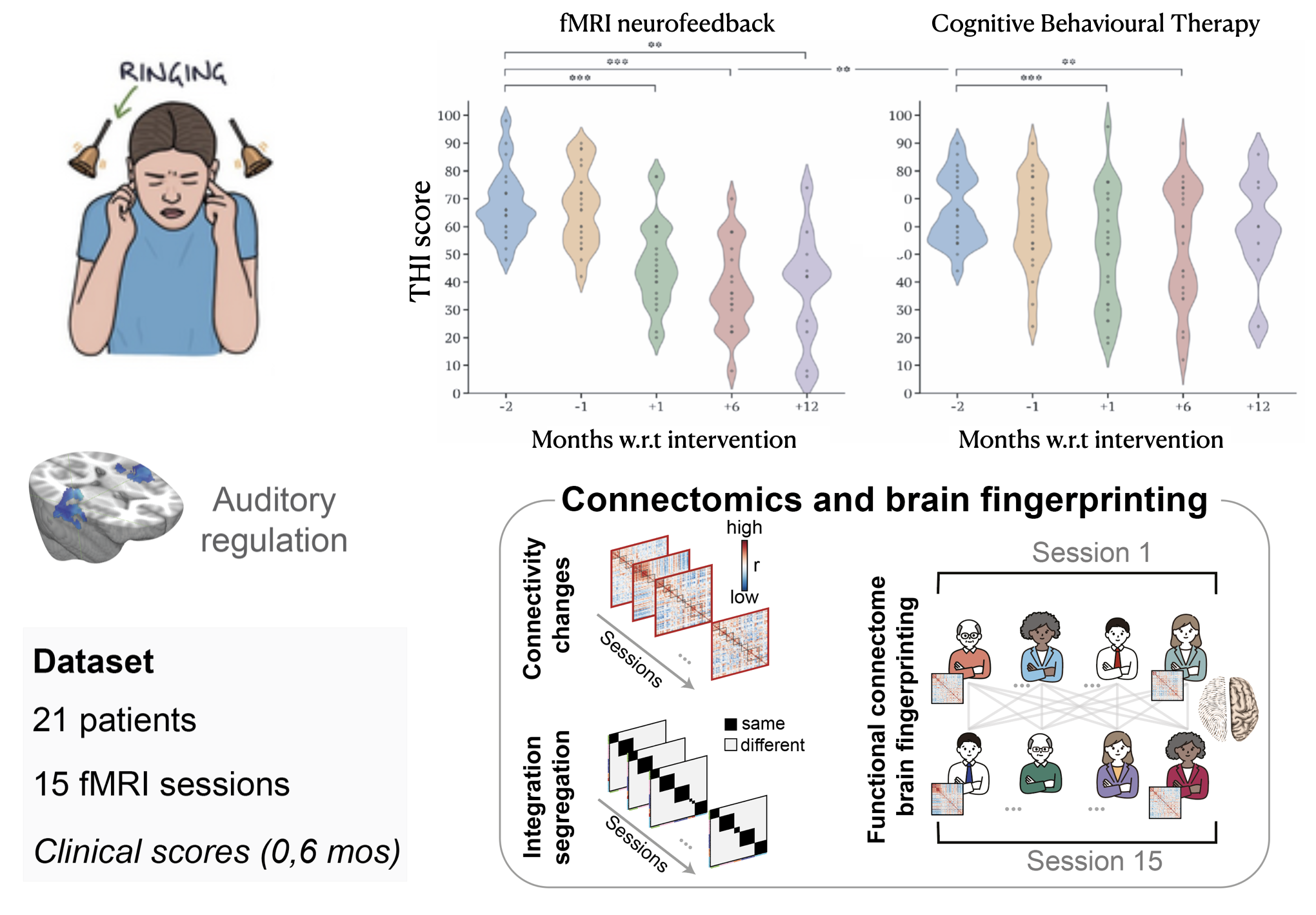
Tinnitus and fMRI

The same tools, used to follow how the brain reorganises after injury or in chronic conditions, one patient at a time.

  • Stroke: over the first year, each patient's functional connectome fingerprint stabilises within three weeks, while system-specific circuits keep remodelling; early functional signatures forecast long-term impairment in language, executive function and attention (bioRxiv 2026)
  • Tinnitus: the impact of higher-order brain interactions in tinnitus patients, with an American Tinnitus Association research grant (co-PI), on which Flavia Petruso (PhD student, EPFL) works part-time
  • Open student project: tinnitus and fMRI neurofeedback
Multilayer Network Visualization
§2.3

Multilayer Networks

Investigation of multilayer network structures and their applications in understanding complex interconnected systems.
  • Complexity and reducibility of multiplex networks
  • Models and measures for multiplex networks
  • Strategies of optimal percolation for multiplex networks
Sperm whale communication and behaviour
§2.4

Project CETI

Project CETI (Cetacean Translation Initiative) is an ambitious interdisciplinary endeavor aiming to decode the communication of sperm whales. By leveraging advanced machine learning, data analysis, and linguistic theory, we seek to interpret the complex vocalizations of these intelligent marine mammals. Understanding their communication patterns offers insights into their social structures and into language and cognition across species.
Computational Gastronomy using network science and topology
§2.5

Computational Gastronomy

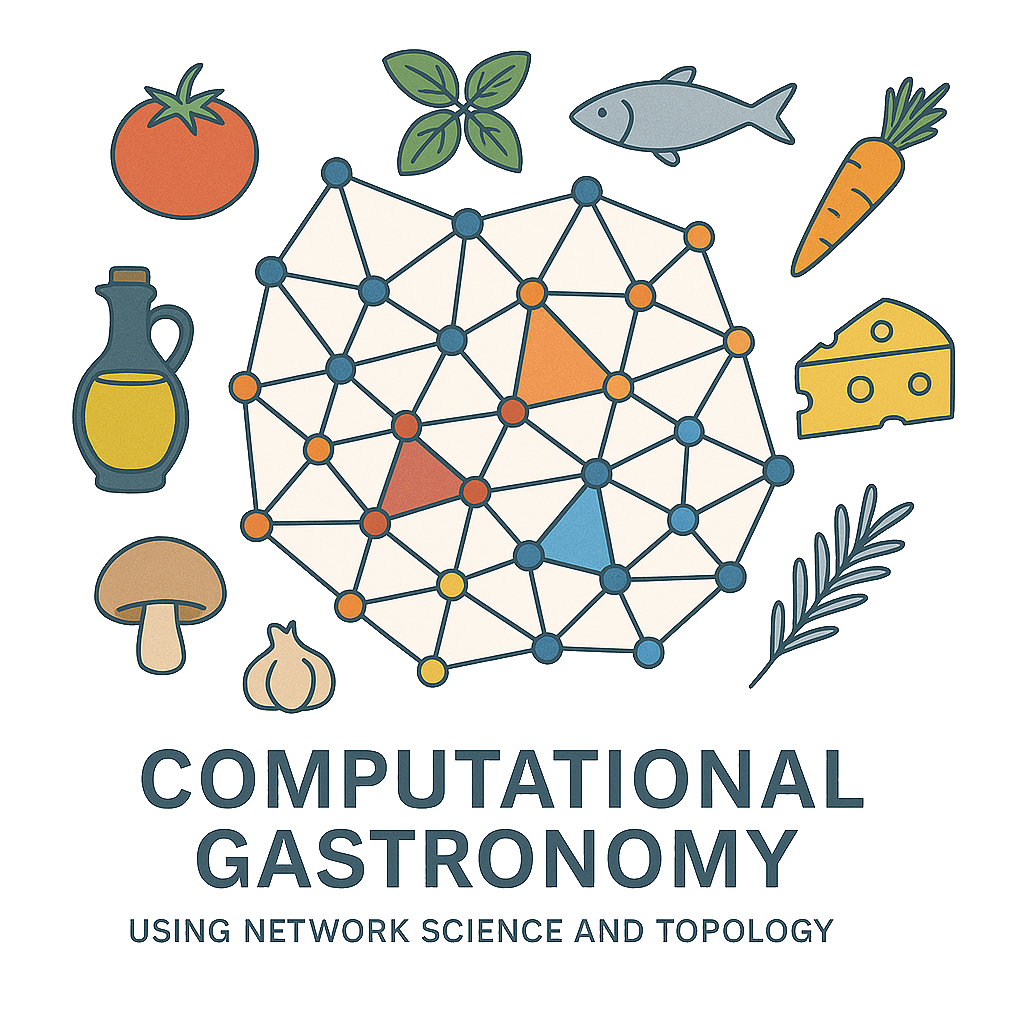
Network approaches to uncover the principles behind how ingredients are combined in cuisines around the world.

  • Networks of ingredient combinations as culinary fingerprints of world cuisines (npj Science of Food)
  • Maximum spanning trees as simplified backbones of cuisines
  • Machine learning to identify cuisines from recipes, and clustering of cuisines into geo-cultural groups
  • Chef Network Platform